


EUR / USD
Source: Massive (polygon.io)
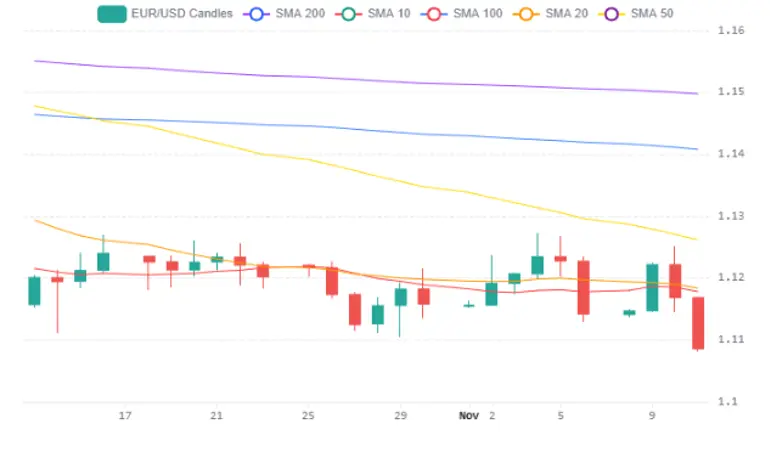
EUR/USD fell about 0.7% over the past day, breaking through 1.110 during the New York afternoon to a one-year low near 1.108, its weakest level since May 2025. The heaviest activity came on that break, which points to conviction rather than thin-market noise. The pair has since stalled in a narrow 1.108–1.110 band.
The main driver is a hawkish repricing of the Federal Reserve after October consumer prices rose 0.4% on the month, with core up 0.3% for a third straight month of firm underlying inflation. Markets fully price a December quarter-point hike from the current 3.75%–4.00% range, with residual odds of a half-point move, and major banks have added hikes in early 2027 to their forecasts. The roughly 94%–95% priced chance of an ECB quarter-point hike on December 17, which would lift the deposit rate to 2.75%, is viewed as defensive given slowing growth, and French fiscal and political strains add to the euro's burden. Higher crude prices tied to the unresolved Strait of Hormuz crisis further weigh on the energy-importing eurozone.
Technically, price sits well below the 20-day average at 1.1183 and the 50-day average near 1.13. A daily RSI near 37 signals bearish momentum that is not yet oversold. A sustained break below 1.108 would expose 1.100, while reclaiming 1.110 could trigger short-covering toward 1.12 and 1.129, a risk heightened by heavily short leveraged positioning. Friday's US producer prices and eurozone third-quarter GDP and unemployment data are the next catalysts, but absent softer US data or progress toward a US-Iran settlement, the widening rate differential favours continued euro weakness.
USD / JPY
Source: Massive (polygon.io)
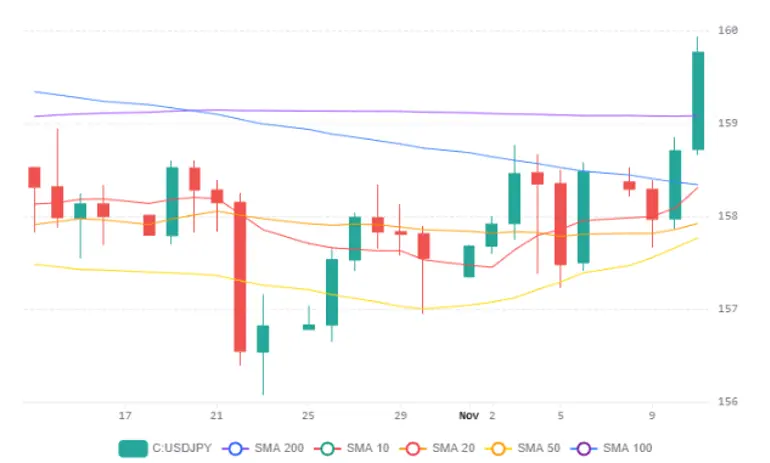
USD/JPY gained about 0.65% over the past day, with heavy early US-session volume driving the pair through the 200-day moving average near 159.1 to a monthly high close to 159.9. The move followed October's hotter-than-expected US CPI (headline +0.4%, core +0.3%), which has markets fully pricing a December Fed hike from the 3.75%–4.00% range. Meanwhile, elevated crude prices tied to the unresolved Strait of Hormuz situation continue to erode Japan's terms of trade.
Offsetting forces are building on the Japanese side. The Bank of Japan is signalling support for further hikes from its 1.25% policy rate, and a 10-year JGB yield near 2.785% has kept the spread with Treasuries from widening meaningfully. Intervention risk also caps the upside, although the gains from this year's record yen-buying, including joint action with the US in July, have largely faded.
Technically, the 20-day average, 50-day average and 30-day VWAP now form stacked support around 157.8–158.0, with the daily RSI near 64. Holding 159.1 on a retest would open a break of 160 toward the July peak near 164, while a close back below 159.1 would mark a failed breakout and expose 158.0, then 157.4.
GBP / USD
Source: Massive (polygon.io)
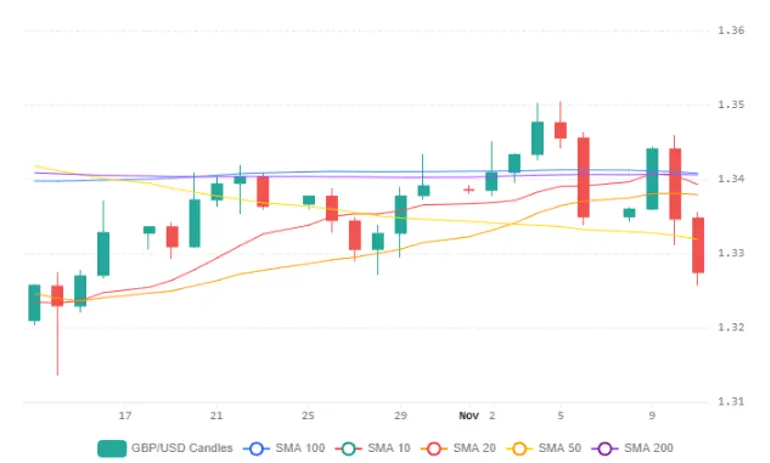
Sterling fell about 0.5% against the dollar over the past day, sliding from near 1.3355 to around 1.3265. Heavy US-session selling extended a pullback of roughly 1.7% from last week's high near 1.3500. A hotter-than-expected October US CPI and hawkish Federal Reserve commentary lifted the dollar index to its strongest level in about nineteen months, and markets now fully price a 25-basis-point Fed hike on December 9.
The Bank of England's hawkish stance, with roughly a 72% chance of a December hike priced in, gives sterling some support. However, rising mortgage costs and softer advertising demand suggest further tightening is straining a fragile UK economy, while higher oil and weaker risk appetite tied to the US-Iran conflict add to the dollar's edge.
Technically, the pair trades below the 20- and 200-day averages near 1.34, with the daily RSI near 42, and is testing the 50-day average and 30-day VWAP around 1.33 as the key pivot. Holding that zone and reclaiming 1.3350 would target 1.34 and 1.3450, while a sustained break below 1.3260 opens the way to the mid-October low near 1.3150, with Thursday's UK GDP and Friday's US producer prices the next catalysts.
Economic Calendar


