EUR / USD
EUR/USD sold off, following the implementation of the new US-EU trade agreement, which establishes a 15% baseline tariff on European goods entering the US market. The euro's decline is further compounded by the EU's substantial financial commitments, including a $600 billion investment in the US and $750 billion in US energy product purchases, which fundamentally strengthen the dollar's position.
Technical analysis reveals a decisive breakdown below the 20-day moving average at 1.1700, triggering a cascade of selling orders that drove the pair toward the critical 50-day moving average support at 1.1565. The heavy institutional selling pressure, particularly evident during European trading hours, resulted in a substantial 1.37% decline, with the pair moving from 1.176 to 1.159.
Market sentiment remains bearish as concerns from major European economies, particularly Germany and France, about the trade deal's impact continue to weigh on the euro, while upcoming Federal Reserve decisions and improving US economic data provide additional support for the dollar's strength.
USD / JPY
USD/JPY demonstrated robust momentum, maintaining positions above key technical indicators, including the 50-day and 20-day moving averages, while the 200-day moving average at 149.63 presents immediate resistance. The currency pair's strength is partially attributed to improving global trade sentiment, particularly following the recent US-EU trade agreement and the US-Japan trade deal, which includes significant Japanese investment commitments.
Market dynamics are heavily influenced by US Treasury yields, with both the Federal Reserve and Bank of Japan's upcoming policy meetings likely to introduce volatility into the pair's trading pattern, especially the subsequent minutes from policymakers on future commitments. Technical analysis suggests further upside potential, with 149.00 representing a crucial barrier, while the daily RSI at 61.0 indicates sustained bullish momentum without reaching overbought territory.
The pair's immediate trajectory will be significantly impacted by this week's comprehensive US economic calendar, including GDP data, PCE inflation figures, and the non-farm payrolls report, while domestic political instability in Japan continues to exert pressure on the yen.
GBP / USD
GBP/USD weakened once again, influenced by the recently announced US-EU trade deal which has created a broad dollar-positive environment. Technical analysis reveals a bearish outlook, with the pair breaking below key moving averages and touching lows near 1.335, while the RSI at 37.00 suggests approaching oversold conditions.
The monetary policy divergence between the Bank of England's increasingly dovish stance and the Federal Reserve's more resilient position is creating fundamental pressure on sterling, particularly as the UK faces a relative lack of major economic catalysts this week. The currency pair's immediate future appears challenging for sterling, with institutional analysts noting that while the pound showed earlier resilience, the combination of shifting monetary policies and broader trade developments could continue to weigh on the pair.
A temporary rebound appears likely in the near term, with a recovery toward 1.36 possible if oversold conditions trigger a corrective bounce. However, the longer-term outlook remains skewed to the downside, with the technical picture suggesting potential support at the 100-day SMA near 1.333. The August 1st trade deadline serves as a crucial upcoming catalyst for price action.
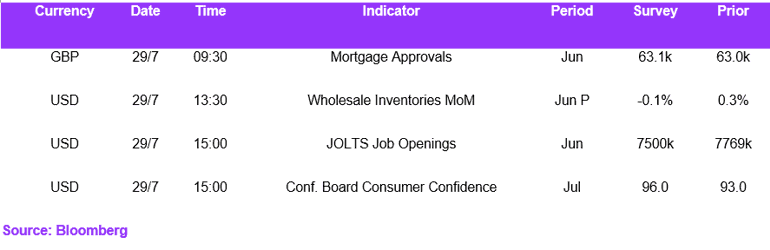
Economic Calendar