EUR / USD
EUR/USD deepened the selloff as recent economic data reveals a stark contrast between US and Eurozone performance, with Germany and Italy both contracting 0.1% while US indicators remain robust. The significant interest rate differential, with the Fed maintaining rates at 4.25-4.50% compared to the ECB's 2.15%, continues to favour dollar strength against the euro.
Technical analysis indicates a decisive bearish trend, with the currency pair breaking below critical moving averages and the RSI entering oversold territory at 29. The newly announced US-EU trade agreement, implementing 15% tariffs on most EU goods, adds another layer of complexity and potential downward pressure on the euro.
The combination of monetary policy divergence, economic growth differentials, and trade tensions suggests continued weakness for the EUR/USD, with the 1.14 support level serving as a crucial threshold that, if breached, could accelerate the decline toward the 100-day moving average at 1.1350.
USD / JPY
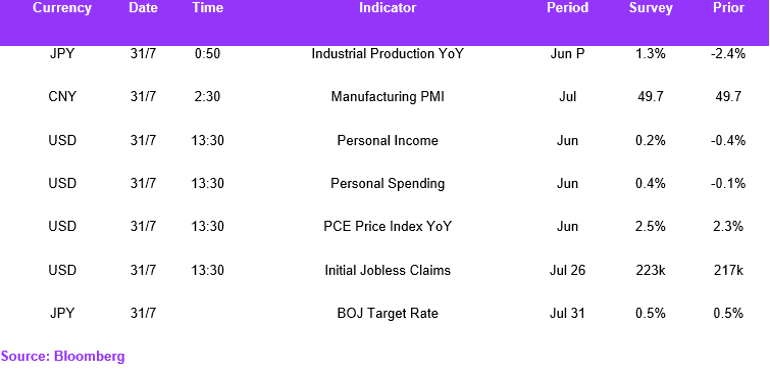
USD/JPY continues to demonstrate bullish momentum, while approaching the significant 200-day moving average resistance at 149.00. The substantial interest rate differential between the US and Japan remains a primary driver for the currency pair, with the Federal Reserve maintaining higher rates while the Bank of Japan cautiously moves toward normalisation.
The recent US-Japan trade agreement, establishing a 15% tariff rate on Japanese goods, has created additional complexity for the BOJ's policy decisions, while political uncertainty following the LDP's loss of its upper house majority has added downward pressure on the yen. Technical indicators suggest potential for further upside movement, with the pair possibly targeting the January high of 158.55 if it maintains momentum above 146.59. However, the currency pair's future trajectory will largely depend on the pace of BOJ policy normalisation relative to global interest rate trends, with market participants closely monitoring BOJ Governor Ueda's communications for signals about future rate adjustments.
The combination of divergent monetary policies, Japan's political uncertainty, and evolving trade dynamics continues to create a challenging environment for the yen, suggesting sustained upward pressure on the USD/JPY pair in the near term.
GBP / USD
GBP/USD has shown significant weakness recently, dropping below the crucial 1.3300 level amid a complex macroeconomic backdrop and strong dollar performance. The decline has been primarily driven by diverging economic fundamentals, with the US showing robust GDP growth of 3.0% in Q2 while the UK faces moderating economic growth and persistent inflation concerns.
Technical indicators suggest the pair is approaching oversold territory, with the RSI at 30 and price action consistently remaining below both the 50-day and 100-day moving averages of 1.3520 and 1.3330, respectively. The Bank of England's hawkish stance on inflation provides some support for sterling, though this is largely overshadowed by broader economic concerns and the Federal Reserve's commitment to maintaining "modestly restrictive" policy. Heavy institutional trading activity observed near 1.32, combined with extreme bearish positioning in the market, suggests the potential for a technical correction, although the 200-day moving average at 1.30 remains a critical support level to watch.
The combination of fundamental headwinds and technical weakness points to continued pressure on the GBP/USD pair in the near term, with the possibility of testing December's lows near 1.30 if current support levels fail to hold.
Economic Calendar