EUR / USD
EUR/USD's upside stalled yesterday, supported only by the 50 SMA on the downside, creating potential vulnerability to sentiment shifts. Technical analysis reveals the pair trading within a defined range between 1.1640 support and 1.170 resistance, with key moving averages at 1.1644 and 1.1622 serving as immediate reference points.
The Federal Reserve's upcoming Jackson Hole symposium could prove pivotal for the pair's direction, with markets currently pricing in a high probability of a September rate cut, while European fundamentals show only modest support with moderating growth prospects.
Recent diplomatic developments between Ukraine and Russia have introduced cautious optimism, though territorial disputes continue to impact euro sentiment. A breach below 1.1600 might lead to a test of 1.15, with the 100-day moving average at 1.1470 providing medium-term support.
USD / JPY
USD/JPY continues to remain rangebound. Despite US pressure, the Bank of Japan maintains its dovish position under Governor Ueda, emphasising the need for sustained wage growth before considering any policy tightening.
The currency pair has demonstrated limited volatility, trading within a tight range between 147.45 and 147.89, while maintaining its position above the critical 50-day moving average at 146.66. Technical analysis suggests potential for moderate upside momentum if buyers can overcome the 20-day moving average at 147.89, with the 200-day moving average at 149.20 serving as the next significant resistance level.
Market expectations for Federal Reserve rate cuts, particularly with an 80-90% probability of a 25bp reduction in September, continue to weigh on the dollar, while the recent strength in Japanese government bond yields, with the 10-year JGB reaching a 3-week high of 1.604%, has provided some support for the yen through improved interest rate differentials.
GBP / USD
GBP/USD faces significant technical and fundamental crosscurrents, with recent price action showing modest weakness as sterling declined 0.13% against the dollar in rangebound trading. The UK's economic landscape presents a mixed picture, with Q2 GDP growth exceeding expectations at +0.3% quarter-over-quarter, though investment figures remain concerning at -4.0% year-to-date.
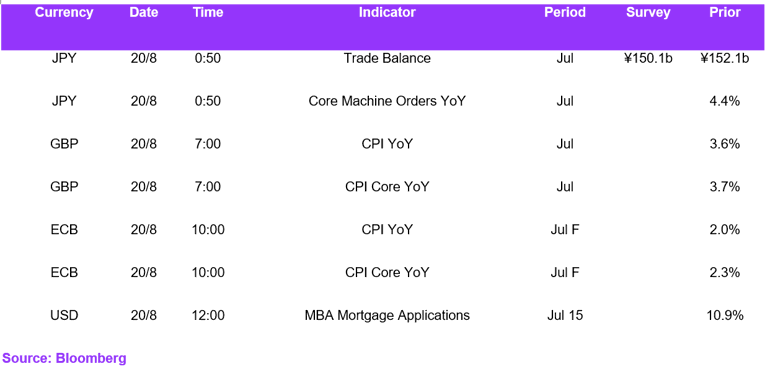
The Bank of England's hawkish stance and anticipated sticky inflation, projected to reach 3.7% in July, continue to provide underlying support for sterling. Technical analysis reveals crucial levels, with immediate resistance at 1.35 and clustered support around 1.34, while the 100-day moving average at 1.3507 serves as a key technical barrier.
The pair's near-term direction appears heavily dependent on upcoming events, particularly the Federal Reserve's Jackson Hole symposium, where markets have priced in an 85% probability of a September rate cut that could significantly impact dollar strength. The technical structure suggests that a breakthrough below 1.34 might trigger a deeper correction toward the 200-day moving average at 1.3014.
Economic Calendar