EUR / USD
EUR/USD is showing resilience despite recent shifts in Federal Reserve policy expectations, with markets now pricing in a 90% probability of a rate cut in September and approximately 100 basis points of easing through 2026. The dollar's broader weakness, coupled with growing concerns about Federal Reserve independence following President Trump's attempt to remove Fed Governor Lisa Cook, has created a supportive environment for the euro.
Technical analysis reveals a bullish bias, with the pair trading above both the 50-day and 20-day moving averages at 1.1665, while the RSI at 56 suggests continued upward momentum. The Eurozone's economic landscape presents mixed signals, with German inflation exceeding expectations and manufacturing PMI data surprising to the upside at 50.7, indicating resilience in the industrial sector despite regional variations.
The pair's immediate outlook appears constructive, with potential for further gains if buyers can overcome the significant resistance level at 1.177, though upcoming US labour market data, particularly the nonfarm payrolls report, could prove pivotal in determining the near-term direction.
USD / JPY
USD/JPY holds firmly in range as the Bank of Japan maintains a more hawkish stance with potential for a 25-basis-point hike by year-end. Technical analysis reveals the pair trading below all major moving averages, with the 200-day SMA at 148.87 serving as immediate resistance, while a cluster of shorter-term moving averages around 147.00-147.49 suggests potential congestion.
Recent Japanese manufacturing data showing continued contraction in factory activity due to falling export orders adds complexity to the currency pair's outlook, though hedge funds are increasingly positioning for yen strength. The combination of potential Fed cuts and BoJ tightening creates a fundamental backdrop that could drive significant yen appreciation, with traders anticipating a possible break below the 145 level.
The upcoming US nonfarm payrolls report will be crucial for near-term direction, as signs of labour market cooling could cement expectations for Fed easing, while a breach of support at 146.1 could trigger a decline toward 144.2.
GBP / USD
GBP/USD demonstrated notable strength, maintaining positions above key technical levels, including the shorter-term moving averages at 1.3500, with an RSI of 57.5 indicating moderate bullish momentum. The pound's resilience is primarily supported by expectations of delayed Bank of England rate cuts, despite ongoing challenges in the UK manufacturing sector, as evidenced by the August PMI falling to 47.0.
The currency pair's upward trajectory, reaching peaks near 1.355, is further bolstered by broad US dollar weakness, with markets pricing in an 87% probability of a September Fed rate cut. A breakthrough above immediate resistance at 1.362 could pave the way for testing the recent high of 1.377, though this scenario heavily depends on forthcoming UK economic data and the Treasury's fiscal measures. The pair's downside risks are centred around the 1.332 support level, with a potential decline toward 1.325 if global risk sentiment deteriorates or UK fiscal concerns intensify.
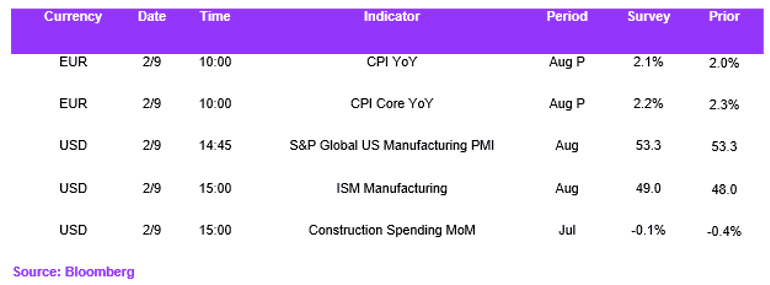
Economic Calendar