EUR / USD
EUR/USD held its nerve at 1.1650 as recent economic data from both regions points to diverging monetary policy paths. The Fed's likely 25 basis point rate cut in September, supported by weakening US labour market data, contrasts sharply with the ECB's more cautious stance, where markets see minimal probability of near-term easing.
Technical analysis reveals the pair trading in a consolidated pattern near the 50-day moving average of 1.1663, maintaining position above the 1,1600 level, with neutral momentum indicated by an RSI of 49. The Eurozone's deteriorating economic conditions, exemplified by July's 0.5% decline in retail sales, combined with geopolitical tensions surrounding Ukraine and French political instability, create growing pressure on the euro.
However, a lot will hinge more on the dollar longer-term performance.
Institutional sentiment appears increasingly bearish, with COT data showing reduced long positions from 123,400 to 118,700 contracts, while key technical levels suggest immediate support at 1.1600 and resistance at 1.1740, setting up potential range-bound trading in the near term.
USD / JPY
USD/JPY demonstrates mixed signals as recent US economic data presents contrasting indicators, with strong Q2 productivity and ISM services data supporting the dollar, while weaker labour market figures create downward pressure. Technical analysis reveals the pair maintaining positions above critical moving averages, with the current RSI reading of 57.44 suggesting room for further upside without entering overbought conditions.
The political landscape in Japan adds complexity to the currency pair's outlook, as the resignation of LDP Secretary General Hiroshi Moriyama could signal a shift toward more expansionary fiscal policies, while the Bank of Japan maintains its cautious approach to monetary policy adjustments. Market participants are closely monitoring the 149.17 resistance level, as a breakthrough could pave the way for a test of the recent high at 150.90, though the increased probability of Fed rate cuts, now priced at 99% for the September FOMC meeting, may limit upside potential.
The pair's immediate trading range appears well-defined, with strong support established at the convergence of the 50-day moving average near 147.31, while maintaining the resistance of 200-day moving average of 148.84.
GBP / USD
GBP/USD remains subdued due to mounting concerns over the UK's fiscal position, with the national deficit at 4.8% creating substantial economic headwinds. The Bank of England's complex challenge of managing sticky inflation, which rose to 3.8% in July, while addressing signs of economic slowdown, has created uncertainty in the market.
Technical analysis shows the pair maintaining position above the 1.3340 mark, consolidating under the 50-day moving average at 1.3477. The divergence in monetary policy expectations between the UK and US appears to be a crucial driver, with markets pricing in a 97% probability of a Fed rate cut in September while the BOE is expected to maintain higher rates for longer. A breakthrough above current levels could trigger momentum toward resistance at 1.3500, while a break below might lead to a decline toward support at 1.333.
The outlook remains cautious given the UK's persistent challenges, including bond market volatility with 30-year gilt yields reaching levels not seen since 1998, reflecting ongoing investor concerns about Britain's fiscal trajectory.
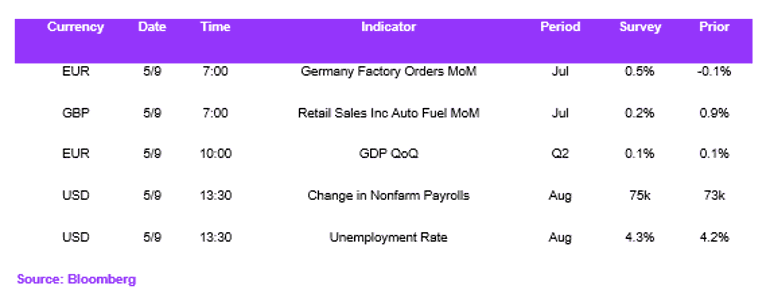
Economic Calendar