EUR / USD
EUR/USD weakened as recent US labour market revisions, showing 911,000 fewer jobs than previously estimated, have dramatically increased expectations for Federal Reserve rate cuts. The market is now fully pricing in a 25-basis point reduction, with even a 12% probability of a 50-basis point cut at the next Fed meeting.
The European Central Bank's stance remains comparatively hawkish, maintaining steady rates amid stable core inflation and record-low unemployment in the Eurozone, creating a fundamental backdrop that could support the euro. Technical analysis reveals that the pair is set to remain elevated, trading above the 50-day moving average at 1.1662 and another longer-term support above 1.1500.
The divergence in monetary policy between the two central banks, with the Fed likely entering an easing cycle while the ECB holds steady, combined with the Eurozone's economic resilience, suggests potential euro strength in the longer term. Political uncertainty in France and the broader impact of US trade policies could introduce additional volatility, albeit their impact is expected to remain limited.
USD / JPY
USD/JPY faces significant downward pressure as markets digest speculation about the Bank of Japan's potential rate hike before year-end, despite Japan's complex political landscape following Prime Minister Ishiba's resignation. Positive Japanese economic indicators, particularly the 8.1% year-over-year increase in August machine tool orders, strengthen the case for monetary policy normalisation and provide fundamental support for the yen.
The dollar's position has weakened considerably due to growing expectations of the Federal Reserve easing, with markets pricing in a 75 basis point rate cut by year-end, coupled with the disappointing revision of US payroll data showing 911,000 fewer jobs through March 2025. Technical analysis reveals a consolidation phase for USD/JPY, with the pair gapping below the 50-day moving average of 147.44 before recovering to 147.45, with the 200-day moving average serving as resistance.
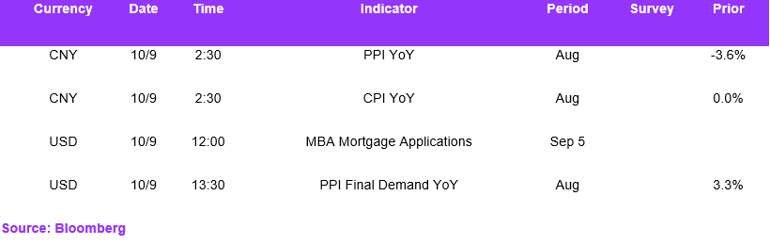
The pair's immediate direction appears contingent on a breakthrough from its current range, with potential targets at 150.9 if bullish momentum prevails above 147.7, or a possible decline toward 140.0 if support at 146.10 fails to hold. The upcoming inflation data and central bank meetings, particularly any policy shifts from the BOJ, will be crucial in determining the pair's trajectory, although Japan's political uncertainty and potential fiscal expansion could moderate the yen's strength.
GBP / USD
GBP/USD continues to find fundamental support from the diverging monetary policy stances between the Bank of England and Federal Reserve, with the BoE maintaining a hawkish position through 2025 while markets price in imminent Fed rate cuts. Recent US labour market weakness, including a substantial downward revision of 911,000 jobs through March 2025, has strengthened expectations for Fed easing, with markets now pricing in 75 basis points of cuts by year-end.
The technical landscape shows the pair trading above key moving averages, with significant support at the 50- and 100-day SMAs (1.3470) while rejecting prices above 1.3595, with institutional activity concentrating around the 1.3540 level. The UK economy's resilience, evidenced by stable retail sales and services sector activity, coupled with the BoE's commitment to fighting inflation, provides a supportive backdrop for sterling despite persistent inflation concerns.
Recent spikes in long-dated gilt yields indicate cooling fiscal concerns for the UK, though the currency pair's future trajectory will largely depend on upcoming US economic data and the evolving central bank policy divergence, with particular attention on US inflation figures that could challenge current Fed rate cut expectations.
Economic Calendar