EUR / USD
EUR/USD fell to 1.1743 yesterday due to a stronger dollar, which appreciated following positive new home sales data that rose to 800,000, the highest level since early 2022. Moreover, from the European side, German business sentiment data showed unexpected deterioration, with the IFO index dropping to 87.7 from 88.9 in September. These macroeconomic figures had a greater impact on the pair than the trends in the central bank's forward guidance, as there is little clarity regarding the Fed's direction.
In particular, remarks by Fed Chair Powell did not provide much clarity on the central bank's future direction, creating uncertainty regarding expectations for a rate cut in October. At the time of writing, forward swaps are pricing in a total of 43bps in cuts by year-end, with a 92% probability of a 25bps cut in October. Policymakers are likely to maintain a traditional wait-and-see approach, waiting for additional labour and inflation data to guide their decisions ahead of the next meeting.
Across the Atlantic, major central banks appear positioned to keep rates unchanged in their upcoming meetings. ECB's Cipollone reiterated that Europe's interest rates are adequately set at the moment, citing no significant threats to inflation in either direction. This sentiment is echoed by market expectations, which indicate no rate cuts are anticipated until the end of the year.
The technical landscape shows the pair trading in a confined range near 1.1700, with multiple moving averages converging at this level. The pair's next significant moves may depend on a breakthrough above 1.1860, which could trigger momentum toward 1.19, with support in the form of moving averages providing solid backing for the pair in the meantime.
USD / JPY
USD/JPY jumped higher, surpassing the crucial 200-day moving average resistance of 148.51, mostly driven by dollar strength during the day. Recent manufacturing data from Japan, showing contraction with September PMI at 48.4, has added downward pressure on the yen while reinforcing the currency pair's upward trajectory.
Technical analysis reveals strong positioning above all major moving averages, with the pair trading between 147.6 and 148.8, suggesting sustained upward momentum. The interest rate differential remains a fundamental factor supporting USD/JPY strength, despite the BOJ's slight shift toward a more hawkish stance.
As the pair approaches the key 149.00 level, markets are likely to respond to a mix of technical strength and fundamental drivers. This could indicate continued upside potential, with the recent high of 150.90 serving as a possible target.
GBP / USD
GBP/USD weakened yesterday, breaching the significant support level at 1.3500, falling to 1.3450, driven by a combination of a stronger dollar and weaker manufacturing and services PMIs in the UK. Still, given the persistent inflation at 3.8%, the UK's stance supports a more hawkish narrative from the BOE in the coming months.
Technical analysis reveals bearish momentum building in the pair, with price action now below critical moving averages, while the RSI reading of 44.00 suggests further downside potential, with the support at 1.3340 being the next crucial level to watch on the downside.
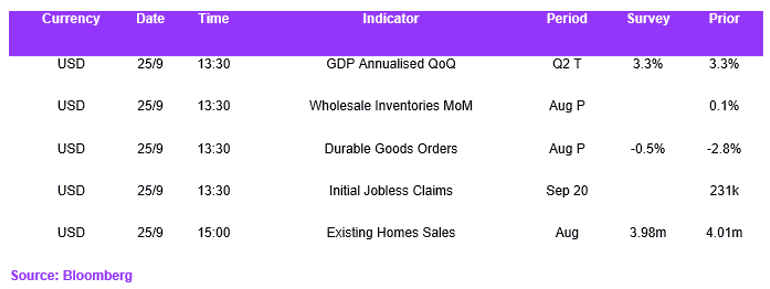
Today, the third estimate of the US GDP for Q2 is expected to remain unchanged at 3.3% QoQ. The strength of this growth is attributed to net exports and personal consumption, which is higher than in Q1 but significantly lower than the average for 2024. While a substantial revision could influence currency movements, it is unlikely to happen. We anticipate that the currency pair will trade within a range of 1.3340 to 1.3500 for the time being.
Economic Calendar