EUR / USD
EUR/USD edged lower as a stronger dollar pushed the pair towards the support of the 50-day moving average of 1.678. The unexpected rise in Eurozone unemployment to 6.3% in August, coupled with manufacturing weakness in core economies, suggests potential limitations to euro strength despite the currency finding some support from easing inflation expectations.
Despite yesterday's recovery, the US dollar is experiencing pressure from multiple fronts, including the government shutdown's disruption of economic data releases and concerning labour market indicators, as evidenced by the 32,000 job decline in September's private employment figures. Markets are now fully pricing in a Fed rate cut at the October meeting, while political uncertainty and challenges to Fed independence add another layer of complexity to dollar sentiment.
The technical outlook shows EUR/USD encountering resistance around 1.1730, with recent price action indicating diminishing momentum as the pair tests support levels near 1.1680. While we expect the pair to remain historically resilient at these levels, given the overwhelming dollar weakness, the upside also seems to be limited, given European macroeconomic and inflation concerns.
USD / JPY
USD/JPY is currently at a critical juncture, influenced by significant shifts in monetary policy dynamics between the Fed and the Bank of Japan. The BOJ's increasingly hawkish stance, evidenced by Deputy Governor Uchida's comments and Japanese bond yields reaching a 17-year high of 1.674%, signals a potential departure from their historically accommodative policy.
The technical landscape shows the pair trading between 147.0 and 147.5, maintaining a position above the crucial 100-day moving average at 146.50, with key resistance near the 200-day moving average at 148.29, which is drifting lower, capping the upside. The markets' pricing of a 100% probability for a Fed rate cut at the October meeting, coupled with recent weakness in US labour market data, has created a notable policy divergence that could fundamentally reshape the pair's trajectory.
Japan's improving domestic conditions, reflected in the consumer confidence index reaching a 9-month high of 35.3, combined with persistent inflation running above target for 29 consecutive months, strengthen the case for continued BOJ policy normalisation. The pair's immediate direction may hinge on its ability to break above the 50-day moving average at 147.81, which could trigger a move toward 149.90, while a breach below the 100-day moving average might initiate a decline toward 146.30.
GBP / USD
GBP/USD faces a complex trading environment shaped by diverging central bank policies and economic uncertainties. The US government shutdown and weaker labour market data have created significant headwinds for the dollar, while the Bank of England maintains a hawkish stance on inflation, particularly emphasised by policymaker Catherine Mann's warnings about continued inflation risks.
Despite recent bearish momentum that saw the pair decline by 0.28% and touch lows of 1.340, the pound has found support from signs of stabilisation in the UK financial services sector. Technical analysis reveals the pair is testing the 50-day moving average at 1.3463, while maintaining crucial support above the 1.3330 level, suggesting a potential consolidation phase.
The market's pricing of a 100% probability for a Fed rate cut in October, coupled with expectations of multiple cuts before year-end, contrasts sharply with the Bank of England's commitment to maintaining elevated rates, providing fundamental support for the currency pair. However, structural challenges for sterling persist, including the UK's significant current account deficit and uncertainty surrounding November's autumn budget, which could limit substantial upside potential.
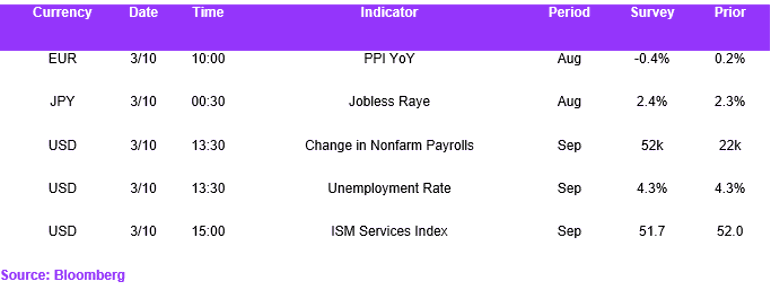
Economic Calendar