EUR / USD
EUR/USD demonstrates resilient performance amid significant macroeconomic developments, with technical indicators suggesting capped upside potential as the pair hovers below the 100-day moving average of 1.1646. The Fed’s anticipated rate cut, with markets pricing in a 98% probability of a 25bp reduction at the upcoming FOMC meeting, combined with the ongoing US government shutdown, is creating substantial headwinds for the US dollar.
The euro finds support from the ECB's hawkish stance, as Governing Council members Dolenc, Makhlouf, and Nagel signal their preference for maintaining current interest rates, despite a modest decline in Eurozone industrial production. The diverging monetary policy trajectories between the Fed and ECB could catalyse further euro appreciation, with the pair potentially targeting the 1.1691 at the 50-moving average level.
However, escalating US-China trade tensions and their impact on global growth prospects, as highlighted by the IMF's reduced growth forecast for 2025, introduce an element of uncertainty that could influence the pair's trajectory. In the meantime, the pair holds within a new support of 1.1542, while capped by the 1.1646 resistance – a break above which could signal a potential change in market sentiment for further gains towards 1.1700.
USD / JPY
USD/JPY is experiencing a moderating downward pressure as the markets continue to digest the news surrounding political shifts in Japan. The political uncertainty in Japan, following the collapse of the governing coalition, combined with escalating US-China trade tensions, has increased safe-haven demand for the yen while simultaneously weighing on dollar sentiment. Market expectations continue to favour Fed rate cuts, with a 98% probability priced in for the October FOMC meeting, while the IMF's recommendation for the BOJ to move "very gradually" with rate hikes suggests a cautious approach to policy normalisation.
Technical indicators also point to stalling downside pressures, as the pair is trading above key moving averages including the 50-day SMA at 148.43 and the 100-day SMA at 147.97. At the same time, the RSI figure of 56.00 suggests a neutral position, with recent action suggesting weakening selling pressures; a thin candle body with support at 150.50 confirms this.
A bullish scenario could materialise if buyers successfully defend the immediate support at 150.20, potentially driving the pair toward resistance at 153.18, though the combination of current market factors points to increased volatility and potential further downside for USD/JPY in the near term. A break below the 50-day SMA could trigger a deeper correction toward the 200-day SMA level, particularly if the divergence in monetary policy expectations between the Fed and BOJ continues to narrow and markets assume a normalisation path from the BOJ at the beginning of 2026.
GBP / USD
GBP/USD rallied yesterday, despite the UK grapples with a deteriorating economic landscape, marked by rising unemployment at 4.8% and cooling wage growth. Technical analysis shows the pair trading between key levels, with support at the 200-day moving average of 1.3262 and resistance around 1.3500, while maintaining a neutral-to-bullish short-term sentiment with an RSI of 47.20.
The dollar continues to benefit marginally from its safe-haven status amid renewed global trade tensions, particularly following the implementation of retaliatory port fees between the US and China. The Bank of England's concerns about market risks and the UK's challenging combination of weak growth and persistent inflation suggest that the pair might struggle above the 1.3500 benchmark in the near term.
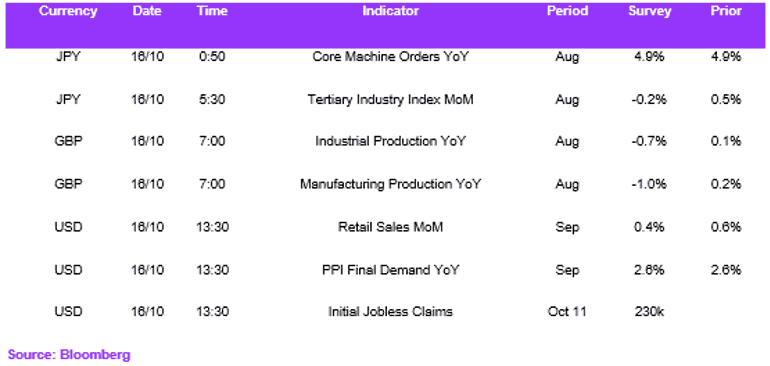
The Fed’s dovish signals regarding potential rate cuts have provided only limited support for sterling, as the US economy's relative resilience continues to underpin dollar strength in the broader market context. As a result, we expect the pair to hold at current levels unless there is positive data out of the US. With markets lacking fresh economic data, the Fed’s guidance at its next meeting becomes even more critical. While October’s 25bps cut is on the table, the probability of a further 25bps move in December is much less certain. Powell will need to cast a clearer signal for year-end so that markets can recalibrate without disorder.
Economic Calendar