EUR / USD
The EUR/USD currency pair is currently navigating a challenging environment with competing fundamental forces. A strengthening US dollar, driven by risk-off sentiment from technology sector turbulence and broader market volatility, is creating headwinds for the pair, even as softer US labor market data, including elevated jobless claims and job openings at five-year lows, keeps expectations for Federal Reserve rate cut firm starting from in June.
From a technical perspective, EUR/USD declined approximately 0.25% over the past 24 hours, trading between support near 1.17 at the 200-day and 50-day moving averages and resistance around 1.18 at the 20-day moving average. The daily RSI settling near 50 reflects market indecision, with a bullish scenario requiring a reclaim of 1.18 to target resistance at 1.186, while a bearish break below 1.17 could accelerate selling toward 1.168.
The European Central Bank's decision to maintain rates at 2 percent, combined with the euro's significant 13-14 percent appreciation over twelve months, adds complexity as currency strength exerts disinflationary pressures while hampering Eurozone export competitiveness. Looking forward, the pair's trajectory will largely depend on monetary policy divergence between the Fed and ECB, alongside resolution of geopolitical uncertainties surrounding trade policy developments.
USD / JPY
The USD/JPY currency pair is currently trading around 156.8, in the environment of divergent monetary policies between the Federal Reserve and Bank of Japan. The Bank of Japan has adopted increasingly hawkish rhetoric, with board members signalling further rate hikes as inflation approaches the 2% target, while the Federal Reserve faces mounting pressure to implement rate cuts in 2026 due to deteriorating US labor market conditions, including accelerating job losses and rising jobless claims. This narrowing interest rate differential fundamentally favours yen appreciation in the medium term.
From a technical perspective, the pair is trading within a contained range between 156.5 and 157.0, with strong support clustered around 156 where the 50-day moving average, 20-day moving average, and 30-day VWAP converge. Japanese fiscal dynamics present competing pressures, as Prime Minister Takaichi's anticipated election victory could drive aggressive fiscal expansion, raising concerns about Japan's already elevated 240% debt-to-GDP ratio and potential currency depreciation. Currency intervention threats near the 160 level remain an implicit ceiling constraining sustained USD/JPY appreciation, while weak Japanese household consumption data, down 2.6% year-on-year in December, creates ambiguity regarding the pace of Bank of Japan normalization.
GBP / USD
The GBP/USD pair experienced significant weakness following the Bank of England's February 5th monetary policy decision, declining 0.92% to trade near 1.353, marking its largest single-day percentage loss since September 2025. The narrow 5-4 vote to maintain rates at 3.75% surprised markets with its unexpectedly dovish composition, as four members voted for an immediate rate cut, substantially exceeding expectations and prompting traders to price in a heightened probability of rate reductions beginning as early as March 2026.
Technical indicators confirm the bearish sentiment, with the pair currently trading at 1.357, positioned below both the 20-day SMA and the 30-day rolling VWAP, while the daily RSI reading of 46 indicates mildly bearish momentum following the pullback from late January's highs near 1.385. The pound's deterioration reflects shifting monetary policy expectations amid a weakening economic outlook, as the Bank of England downgraded growth forecasts to 0.9% for 2026 and raised unemployment projections to 5.3%.
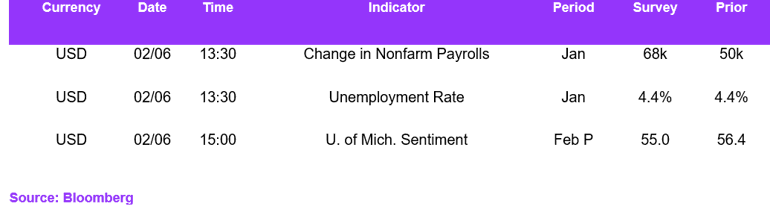
Looking ahead, a bullish scenario would require buyers to push prices back above the 1.360 resistance cluster, while a decisive break below 1.350 could accelerate selling toward the established support zone at 1.330. Near-term catalysts include today US labour data releases, with broader global risk sentiment remaining fragile given ongoing technology sector volatility that continues to support defensive positioning in the US dollar.
Economic Calendar