EUR / USD
Source: Massive (polygon.io)
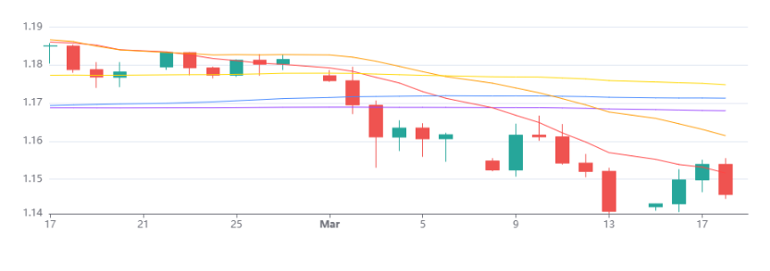
EUR/USD remains under downward pressure as a convergence of fundamental and technical factors reinforces the dollar's strength, capping the pair’s upside. Continued geopolitical tensions in the Middle East have driven crude oil prices to around $100 per barrel, disproportionately penalising the energy-import-dependent eurozone and creating a stagflationary backdrop that fundamentally undermines the euro. The widening monetary policy divergence between the Fed and the ECB further compounds this weakness, as stubborn US producer price inflation at 3.4% YoY and collapsing rate-cut expectations anchor real interest rate differentials firmly in favour of the dollar.
From a technical perspective, the pair's decline to approximately 1.1460 places it well below all major moving averages, while the daily RSI at 34 confirms persistent suppressed momentum consistent with the past month's nearly 3% selloff. The critical near-term level to watch is the support zone around 1.1415, the recent multi-month low, where a decisive break would open the door to an accelerated move toward the 1.1350–1.1300 area.
Capital flows continue to favour dollar-denominated safe-haven assets amid elevated energy prices, geopolitical uncertainty, and more hawkish US real rate prospects, leaving EUR/USD trapped in a pattern of lower highs. Without material improvement in Europe's energy security outlook or a meaningful de-escalation in Middle Eastern hostilities, the pair is likely to remain on a downward trajectory toward the 1.14–1.15 range over the medium term.
USD / JPY
Source: Massive (polygon.io)
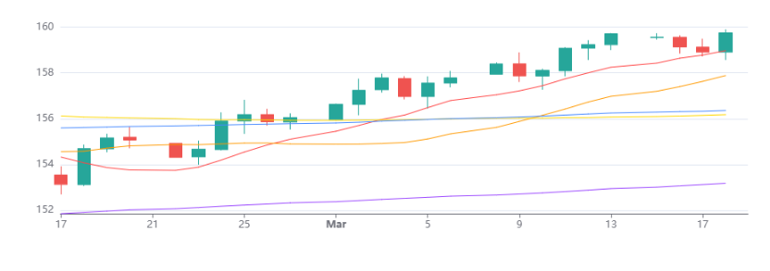
USD/JPY is trading in a strong bullish posture near the psychologically critical 160 level, underpinned by persistent monetary policy divergence between the Fed and the Bank of Japan. The Fed's maintenance of current conditions amid sticky inflation - with markets now pricing only a single rate cut in 2026 - supports structurally elevated U.S. Treasury yields that continue to attract capital flows away from the yen, a dynamic reinforced by Japanese holdings of US Treasuries reaching their highest levels since mid-2022. Meanwhile, the BoJ's expected hold at 0.75% reflects its reluctance to tighten aggressively, while elevated crude oil prices threaten Japan's energy-dependent economy, despite underlying inflation remaining above target for nearly four years and strengthening wage growth maintaining a forward-looking tightening bias.
From a technical standpoint, the pair's decisive surge to a three-month high near 160 confirms robust bullish momentum, though the elevated RSI near 68 and late-session profit-taking around 159.75 suggest consolidation risk at this key resistance zone. The yen's weakness further reflects the market's assessment that elevated oil prices pose a more immediate economic threat to Japan than currency depreciation, while Prime Minister Takaichi's preference for a weaker yen to support export competitiveness limits political will for aggressive intervention despite government warnings near the 160 level.
Looking ahead, a clean break above 160 could catalyse a move toward the 2024 all-time high near 162, but the pair remains vulnerable to sharp reversal should the BoJ signal a more aggressive tightening path than the roughly 60% probability of an April hike currently priced by markets. Ultimately, the trajectory of USD/JPY hinges on developments in crude oil markets, the pace of BoJ policy normalisation, and the sustainability of the U.S. yield premium in an increasingly complex global inflation environment.
GBP / USD
Source: Massive (polygon.io)
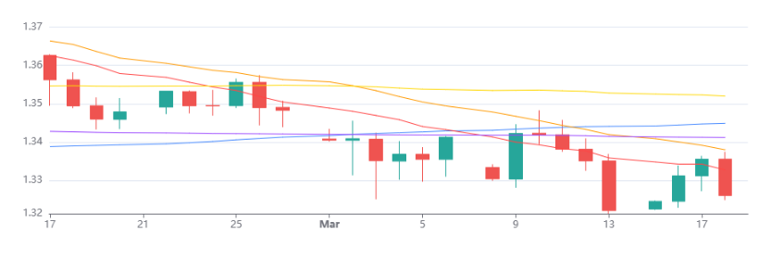
GBP/USD is under significant pressure from both structural macroeconomic forces and deteriorating technical conditions, painting a bearish picture across multiple timeframes. The British pound faces persistent headwinds from the UK's weak productivity growth, and rising public debt levels - all of which stand in stark contrast to the superior growth potential of the US economy. Monetary policy divergence further compounds sterling's vulnerability, as the Fed maintains a hawkish posture at 3.5%-3.75% with no urgency to cut, while the Bank of England faces mounting pressure to eventually ease despite sticky core inflation near 3.1%.
The technical picture reinforces the fundamental bearish bias, with the pair breaking sharply lower during the New York session to settle near 1.326, decisively below the clustered 200-day, 50-day, and 20-day simple moving averages around 1.34–1.35, all of which now serve as overhead resistance. The daily RSI at approximately 37 confirms bearish momentum, while the late-session volume spike during the breakdown suggests genuine selling conviction rather than a temporary liquidity-driven move. Should the nearby support at 1.3238 fail to hold, the path opens toward the early-April 2025 lows near 1.3015, with limited technical support in between.
The confluence of widening growth differentials, asymmetric central bank positioning, geopolitical safe-haven flows favouring the dollar, and a decisively broken technical structure suggests that any tactical rebounds toward the 1.33–1.34 zone are likely to be capped, leaving the broader trajectory for GBP/USD skewed to the downside.
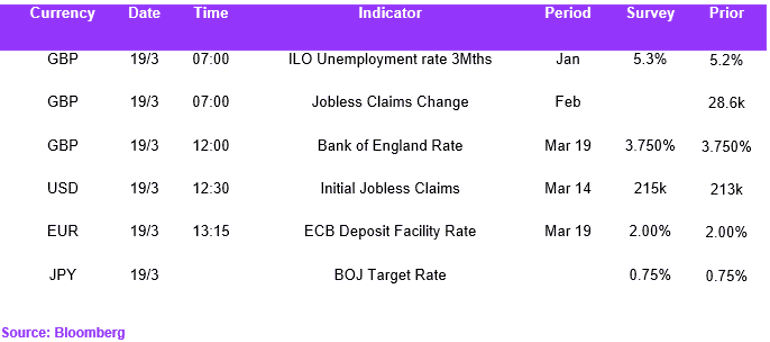
Economic Calendar