


EUR / USD
Source: Massive (polygon.io)
EUR/USD remains under significant bearish pressure as the broader macro backdrop continues to favour the US dollar. Elevated oil prices above USD 110 per barrel, driven by the Iran conflict, alongside rising US Treasury yields with the ten year yield approaching 4.687%, have reinforced a hawkish repricing of Federal Reserve expectations. The widening transatlantic yield differential continues to support demand for dollar denominated assets and maintain pressure on the euro.
The eurozone offers little in the way of a meaningful counterbalance. First quarter 2026 growth slowed to just 0.1%, while expectations for ECB tightening remain modest relative to the shift underway in US rates markets. Elevated energy costs continue to raise stagflation concerns and leave policymakers facing a difficult balance between inflation risks and weakening activity.
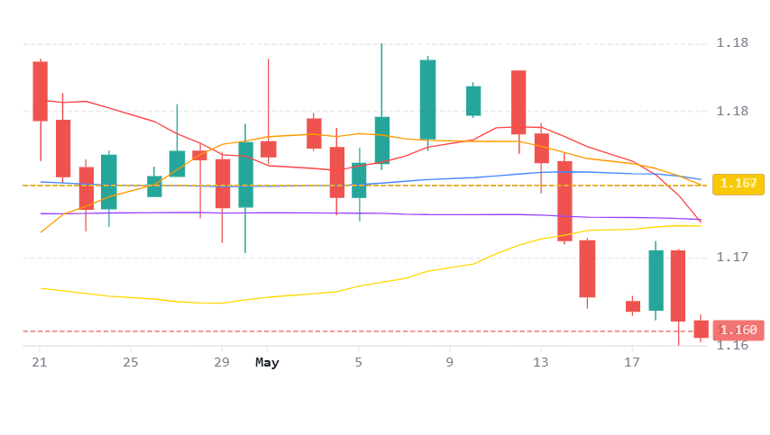
The technical picture remains aligned with this softer fundamental outlook. EUR/USD declined 0.36% to close near 1.1596 and remains below the key moving average cluster around 1.1700, while the daily RSI near 39 suggests bearish momentum remains firmly intact. Institutional positioning reinforces this cautious view, with larger investors appearing to distribute euro longs into rallies rather than build fresh exposure.
Attention now turns to today’s Federal Reserve meeting minutes. Any discussion around tighter policy risks could reinforce dollar strength and leave the 1.1590 to 1.1595 region vulnerable. A sustained break lower may expose downside towards the 1.1450 area, while a recovery would first need to reclaim the 1.1700 resistance cluster to improve the broader outlook.
USD / JPY
Source: Massive (polygon.io)
USD/JPY remains caught between persistent dollar strength and increasingly hawkish expectations surrounding Bank of Japan policy. Yield differentials remain the dominant driver, although expectations for rates to rise towards 1.0% are beginning to provide a medium term source of support for the yen.
Japanese institutional investors reportedly sold almost USD 30 billion of US Treasuries during the first quarter, highlighting a broader portfolio shift that may gradually encourage repatriation flows back into Japan. However, elevated US yields continue attracting capital into dollar assets and are likely to support the pair in the near term.
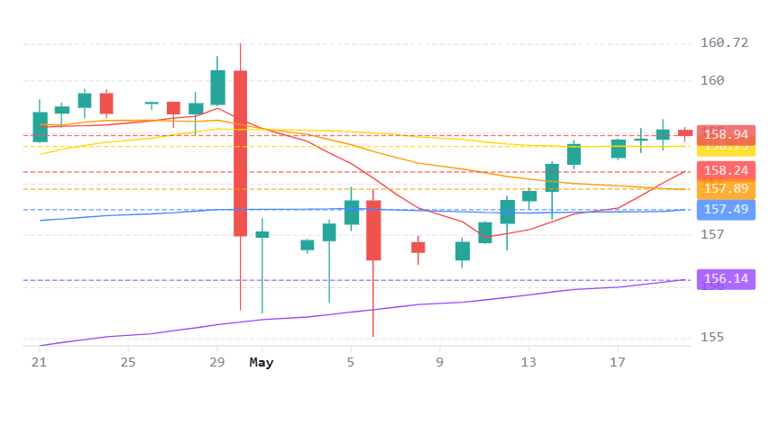
From a technical perspective, USD/JPY is trading near 158.94 between the 50 day moving average at 158.77 and resistance around 159.25. Daily RSI at 56 points to moderate upside momentum, although repeated selling pressure above 159.20 suggests buyers remain cautious. The 160 level remains especially significant given the increasing probability of stronger intervention rhetoric from Japanese authorities.
Looking further ahead, medium term risks may begin to shift more favourably towards yen appreciation if Bank of Japan tightening gradually narrows interest rate differentials. However, unless US yields begin to stabilise, the 158.77 to 160.65 range is likely to remain the key battleground in the weeks ahead.
GBP / USD
Source: Massive (polygon.io)
GBP/USD remains under pressure as a combination of domestic weakness and broader dollar strength continues to weigh on sterling. The Iran conflict and ongoing disruption across energy markets have kept Brent crude above USD 110 per barrel, reinforcing inflation concerns and contributing to a broader bond sell off that continues to underpin the dollar.
Domestic conditions remain challenging. The UK labour market is weakening more quickly than expected, with unemployment rising to 5.0%, payroll employment declining sharply and wage growth moderating. These developments have prompted markets to scale back expectations for additional Bank of England tightening, while political uncertainty surrounding Prime Minister Starmer continues to weigh on sentiment.
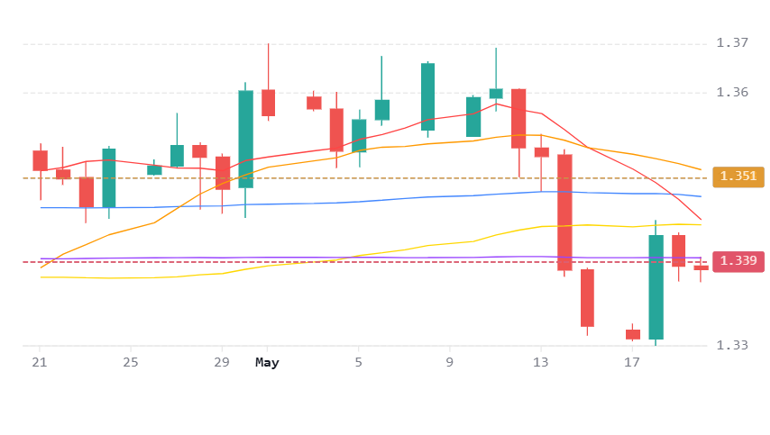
From a technical perspective, GBP/USD is trading near 1.339 around the converging 50 day and 200 day moving averages near 1.34, while the daily RSI around 43 suggests momentum remains fragile. UK CPI will be the key focus this week and could determine whether current support levels hold.
The balance of risks remains tilted to the downside. A sustained move below 1.338 could expose support near 1.326 and reinforce the broader bearish trend. Any recovery towards 1.35 would likely require softer US data and a meaningful stabilisation in geopolitical risks.

