


EUR / USD
Source: Massive (polygon.io)
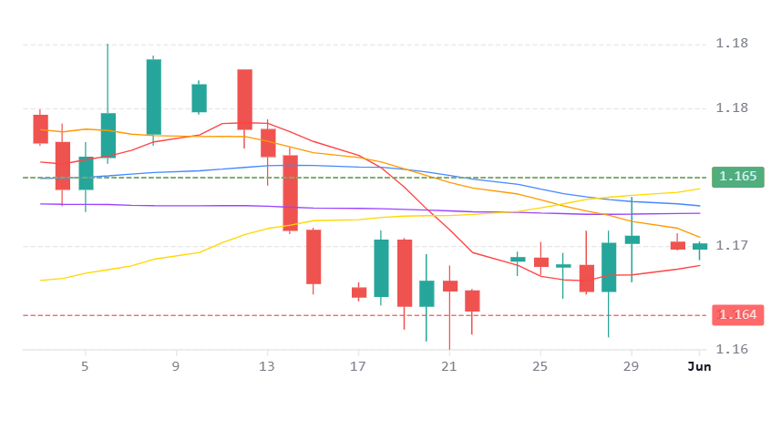
EUR/USD continues to consolidate around the 1.1650 area, with price action remaining trapped beneath a significant resistance cluster formed by the 20 day, 50 day and 200 day SMAs near 1.1700. The pair ended last week at 1.1657 after failing to sustain gains towards this zone, highlighting the importance of the 1.1700 area as the key technical hurdle for any broader recovery.
From a fundamental perspective, the ECB's increasingly hawkish rhetoric continues to provide underlying support for the euro. Inflation has remained above target for a third consecutive month and price pressures are becoming more broad based, which supports expectations that policy will remain restrictive for longer. At the same time, uncertainty surrounding the Federal Reserve outlook has increased ahead of the June nonfarm payrolls report, with softer labour market expectations raising questions over the strength of US growth momentum. We see this narrowing the policy gap modestly in favour of the euro.
However, Europe's vulnerability to prolonged energy market disruptions remains a significant constraint. Elevated oil prices and continued uncertainty surrounding the Strait of Hormuz continue to pose risks to growth and inflation, limiting the scope for sustained euro appreciation. Looking ahead, we expect the 1.1700 resistance zone to remain pivotal. A decisive break higher could open the way towards 1.1800, while another rejection would leave the pair vulnerable to a retreat towards 1.1640 and potentially the 1.1556 support area. Alongside geopolitical developments, this week's US labour market data is likely to be the key catalyst.
USD / JPY
Source: Massive (polygon.io)
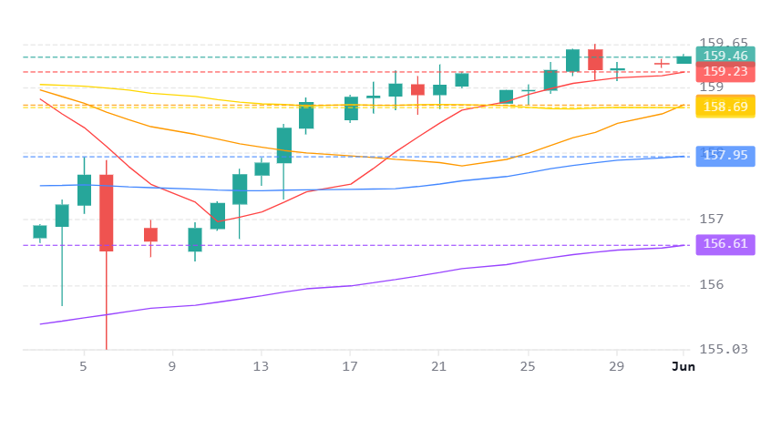
USD/JPY remains firmly supported near 159.50, trading comfortably above its major moving averages, with the 20 day and 50 day SMAs converging around 158.75 and the 200 day SMA providing broader support near 156.58. Daily RSI near 59 continues to point to constructive momentum without yet signalling overbought conditions.
The fundamental backdrop remains supportive for the pair. The Federal Reserve continues to maintain a restrictive policy stance and markets are increasingly considering the possibility of further tightening should energy driven inflation remain elevated. In contrast, uncertainty persists around the Bank of Japan's June policy meeting, with policymakers still divided on the pace of further normalisation. We continue to see monetary policy divergence as the dominant driver of the pair.
Japan's exposure to higher energy prices remains a key challenge. Ongoing disruption in the Strait of Hormuz continues to worsen Japan's terms of trade and weighs on the yen's traditional safe haven appeal. At the same time, recent intervention efforts have had only a temporary impact on price action, reinforcing the view that policy adjustments rather than intervention alone are required to alter the longer term trend.
Looking ahead, resistance at 160.27 remains the key upside level. A sustained move above this area would bring the April high near 160.65 back into focus. On the downside, support around the converging 20 day and 50 day SMAs should remain important. We expect markets to remain highly sensitive to both Bank of Japan communication and developments in energy markets.
GBP / USD
Source: Massive (polygon.io)
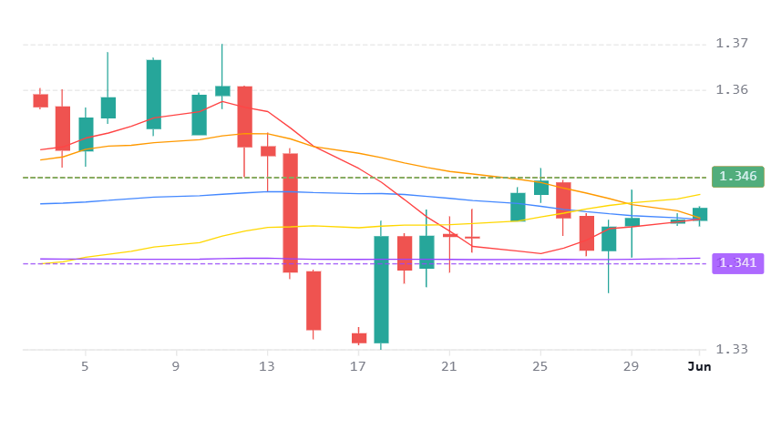
GBP/USD is trading around 1.3464, sitting just below a key resistance band between 1.3500 and 1.3530 where the 20 day and 50 day SMAs converge. The 200 day SMA near 1.3400 continues to provide support, leaving the pair caught between important technical levels.
The broader macro backdrop remains challenging for sterling. The Bank of England continues to push back against expectations of near term rate cuts as services inflation remains elevated, but the market is increasingly focused on the possibility that the Federal Reserve may need to maintain restrictive policy for longer. We see this policy dynamic continuing to favour the dollar, particularly while US inflation remains elevated and geopolitical risks support safe haven demand.
The upcoming US nonfarm payrolls report is likely to be the most important near term catalyst. A stronger labour market reading would reinforce expectations that US rates remain higher for longer and could trigger another rejection from the 1.3500 to 1.3530 resistance zone. Conversely, softer data could provide the catalyst needed for a move towards the monthly high near 1.3650.
Geopolitical developments remain an important swing factor. Any progress towards a US Iran ceasefire could ease safe haven demand for the dollar and provide support for sterling. Nevertheless, while GBP/USD remains below the key resistance cluster, we continue to see risks tilted modestly to the downside, with a failure at 1.3500 potentially opening the way back towards 1.3400 and then 1.3330.

