


EUR / USD
Source: Massive (polygon.io)
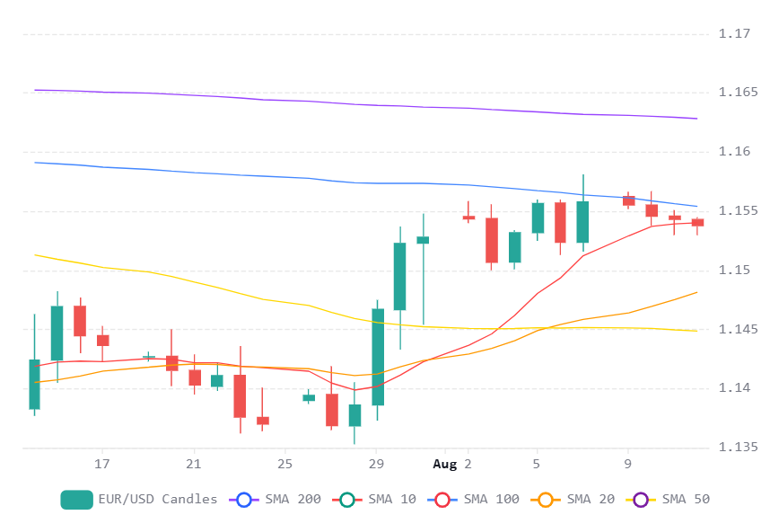
EUR/USD is consolidating around 1.1537, holding just above the 20 day SMA near 1.1500 while remaining capped by the 200 day SMA around 1.1600. The daily setup therefore remains finely balanced, with the recent recovery losing some momentum as markets await the US July CPI release. Following the unexpectedly weak payrolls report, markets are now pricing roughly even odds of a September Fed rate increase, leaving US inflation as the key near term driver.
The fundamental backdrop still provides the dollar with a modest advantage. A stronger than expected core CPI reading could revive expectations of further Fed tightening, particularly with the US 10 year Treasury yield around 4.69%. Geopolitical risks also remain important, with Brent crude above USD 89 per barrel amid continued disruption around the Strait of Hormuz. We see this as a particular challenge for the eurozone given its greater exposure to imported energy costs, although higher German yields and existing ECB tightening expectations provide some offsetting support.
We expect EUR/USD to remain sensitive to US data in the absence of a fresh European catalyst. A sustained move above 1.1600 would improve the technical picture and create scope for a broader recovery, while a failure to defend 1.1500 could expose the pair to renewed selling towards 1.1400 and potentially the 1.1329 support area.
USD / JPY
Source: Massive (polygon.io)
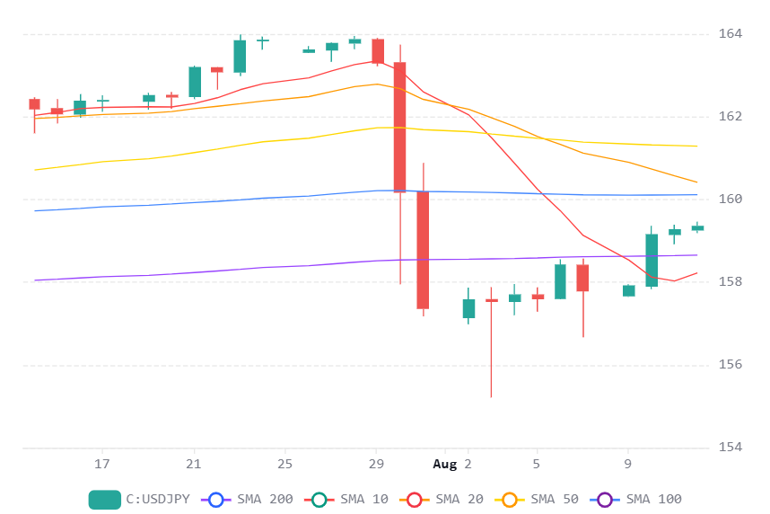
USD/JPY is consolidating just below the psychologically important 160 level, trading around 159.36 as the impact of the coordinated US and Japanese intervention continues to fade. The pair remains below the 20 day SMA near 160 and the 50 day SMA and 30 day VWAP around 161, while the 200 day SMA near 159 is providing immediate support. The daily RSI around 44 points to subdued momentum following the decline from July highs.
The underlying rate differential remains supportive for the dollar, with US 10 year Treasury yields around 4.69% compared with Japanese government bond yields near 2.85%. Elevated oil prices provide an additional challenge for Japan as a major energy importer, while fiscal constraints could limit the pace at which the BoJ is able to normalise policy. Against this backdrop, we see US inflation as the immediate catalyst capable of determining whether USD/JPY can regain the 160 handle.
A stronger US CPI print could revive Fed tightening expectations and support a move through 160, although renewed intervention risk is likely to become increasingly important as the pair moves higher. Conversely, softer inflation could reinforce resistance around current levels and place the 159 area under pressure. Over the medium term, we expect sustainable yen appreciation to require clearer evidence of further BoJ tightening and a more meaningful narrowing of the US and Japanese yield differential.
GBP / USD
Source: Massive (polygon.io)
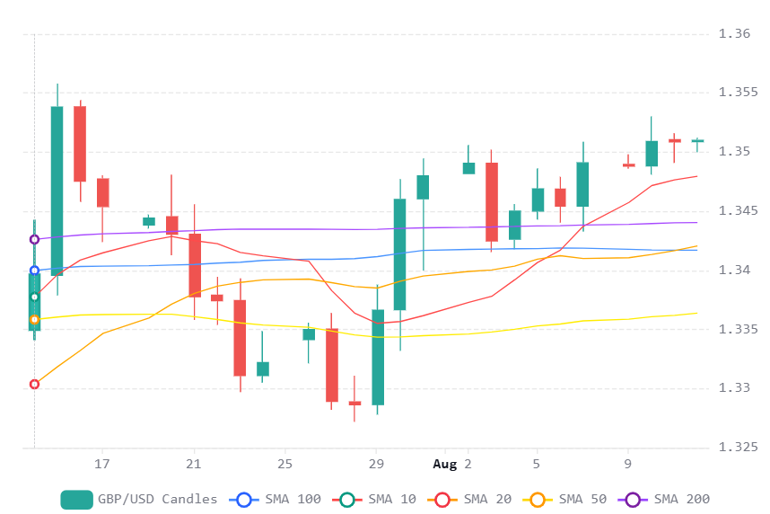
GBP/USD is consolidating around 1.3510, comfortably above the major moving average cluster near 1.3400. The 20 day, 50 day and 200 day SMAs, alongside the 30 day VWAP, provide a relatively strong technical base, while the daily RSI near 61 points to firm momentum without suggesting that the pair is excessively stretched.
The fundamental backdrop is somewhat more supportive for sterling, with three Bank of England MPC members favouring higher rates while markets remain divided over whether the Fed will tighten again in September. However, geopolitical risks continue to complicate the outlook. Brent crude around USD 89 to USD 90 per barrel presents an inflationary challenge for the UK as a net energy importer, while sluggish domestic growth could constrain the extent to which the BoE can respond through tighter policy.
We see US CPI as the first major test for the recent sterling recovery, followed by Thursday’s UK GDP release. Softer US inflation could support a break above 1.3547 and extend the recovery, while a stronger print would likely revive dollar demand and put the 1.3400 moving average cluster back into focus. UK GDP will then determine whether the domestic backdrop is strong enough to sustain the relatively hawkish BoE narrative.


