


EUR / USD
Source: Massive (polygon.io)
EUR/USD is navigating an important technical juncture as the monetary policy gap between the Federal Reserve and the European Central Bank begins to narrow. The Fed’s decision to hold rates at 3.50% to 3.75% in July, alongside softer US inflation and weaker employment data, has reduced expectations of a September rate increase to around 40%. In contrast, eurozone inflation at 2.9% and resilient second quarter growth of 0.4% continue to support expectations of a 25 basis point ECB increase in September. We see this shift in relative policy expectations becoming increasingly supportive for the euro over the medium term.
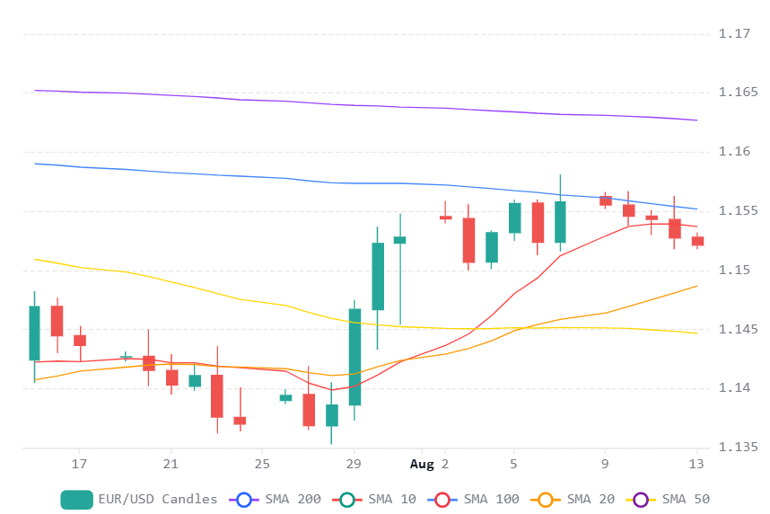
Technically, EUR/USD is consolidating above the important 1.1500 support area, where the 20 day SMA and 30 day VWAP converge, while the 200 day SMA near 1.1600 remains the principal upside barrier. The failure to sustain gains above 1.1560 during the 12 August session suggests sellers remain active at higher levels, although continued buying interest above 1.1500 keeps the recent recovery intact.
Geopolitical risks remain an important counterweight, with tensions surrounding the Strait of Hormuz keeping crude prices around USD 88 to USD 89 per barrel and providing intermittent safe haven support for the dollar. Looking ahead, we expect incoming US PPI and employment data, followed by Jackson Hole commentary, to determine whether EUR/USD can challenge 1.1600. A sustained break above this level would strengthen the recovery outlook, while a loss of 1.1500 would weaken the current constructive bias.
USD / JPY
Source: Massive (polygon.io)
USD/JPY is trading near 159.36, caught between a still sizeable US and Japanese yield differential and growing expectations that monetary policy could gradually converge. US 10 year Treasury yields remain around 4.69% compared with Japanese government bond yields near 2.84%, maintaining an underlying carry advantage for the dollar. However, softer US inflation and employment data have reduced expectations of further Fed tightening, while Japanese wholesale inflation at 7.2% has strengthened the case for another BoJ rate increase in September.
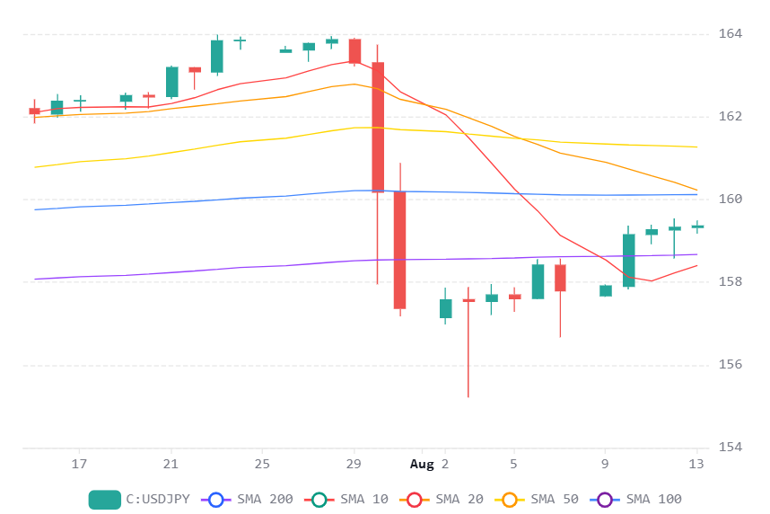
The technical picture reflects this changing balance. USD/JPY remains below the 20 day SMA at 160.22, the 30 day VWAP at 160.81 and the 50 day SMA at 161.27, while the 200 day SMA near 158.67 has provided firm support. The daily RSI around 44 points to a modest downside bias, although buying interest around the 200 day SMA suggests conviction behind further yen appreciation remains limited for now.
We expect the September policy meetings to become increasingly important for the medium term direction. A BoJ increase alongside a continued Fed pause would narrow the yield differential and could push USD/JPY back towards 156. Conversely, a recovery above 160.22 would weaken the bearish technical picture and refocus attention on the 160.81 to 161.27 resistance area. Intervention risk remains relevant, but sustainable yen strength will ultimately depend more heavily on genuine policy convergence.
GBP / USD
Source: Massive (polygon.io)
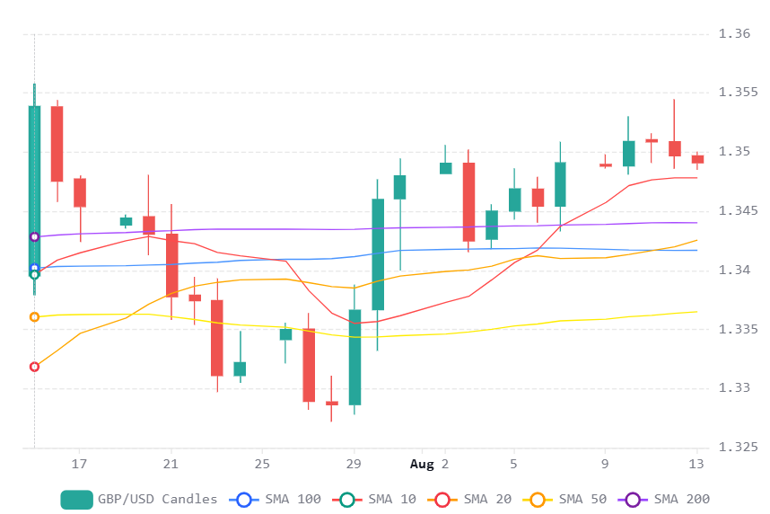
GBP/USD is consolidating around 1.3490 after retreating from a session high near 1.3540, while remaining comfortably above the key moving average cluster around 1.3400. Softer US inflation and weaker July employment data have reduced expectations of further Fed tightening, providing underlying support for sterling. However, UK inflation easing to 3.2% and markets assigning around a 60% probability to a BoE rate reduction are limiting the pound’s ability to capitalise fully on recent dollar weakness.
Attention now turns to UK second quarter GDP. A stronger reading would reinforce the case for the BoE to remain cautious about easing and could provide renewed support for sterling, while weaker growth would risk accelerating expectations of lower rates. Elevated crude prices around USD 88 to USD 89 per barrel add another layer of uncertainty, potentially increasing UK inflationary pressures while simultaneously supporting the dollar through safe haven demand.
Technically, we see 1.3485 as an important near term support level. Holding above this area and reclaiming 1.3540 would bring resistance around 1.3550 back into focus. Conversely, a sustained move below 1.3485 could encourage a deeper correction towards the 1.3400 region, where the 20 day, 50 day and 200 day SMAs converge. The relative Fed and BoE policy outlook remains the principal structural driver, leaving the pair particularly sensitive to incoming growth and inflation data.


