EUR / USD
The EUR/USD pair faces pressure as monetary policy divergence between the Federal Reserve and European Central Bank becomes more pronounced, with the Fed's recent 25bps rate cut contrasting against the ECB's steadfast position. Technical analysis reveals a concerning pattern, with the currency pair experiencing sharp declines to test critical support at the 200-day moving average near 1.15, though oversold conditions suggest limited downside potential in the immediate term.
While German manufacturing data and broader Eurozone indicators point to economic stabilization, the growth outlook remains subdued, creating a complex backdrop for the euro. The ECB's commitment to maintaining higher rates provides fundamental support for the euro, but this may be overshadowed by the Fed's increasingly dovish stance and its implications for interest rate differentials. Near-term price action will likely be determined by the battle between technical support at 1.15 and resistance around 1.17, with a break of either level potentially triggering significant directional momentum. The combination of policy divergence and technical factors suggests continued volatility ahead, with risks tilted to the downside unless the pair can decisively break above the 50-day moving average at 1.17.
USD / JPY
The USD/JPY pair has demonstrated remarkable strength, breaking through critical resistance levels to reach new highs around 153.38, supported by significant trading volume during European hours. The Bank of Japan's decision to maintain its benchmark interest rate at 0.5% has contributed to sustained yen weakness, despite internal dissent from two board members who favoured a more aggressive rate hike to 0.75%.
The currency pair's technical outlook remains decidedly bullish, trading consistently above all major moving averages, with the 20-day SMA at 151.89 serving as the nearest technical support. While most economists anticipate a rate hike either in December or by March 2026, Prime Minister Takaichi's known preference for accommodative monetary policy introduces uncertainty into the timing of any policy normalization.
The technical setup suggests potential for further upside movement, with the previous year's high of 158.55 serving as a possible target if the pair maintains momentum above 153.50, though immediate support at 152.50 remains crucial for maintaining the bullish trajectory.
GBP / USD
The GBP/USD pair faces downward pressure as the UK's fiscal outlook deteriorates, with the Office for Budget Responsibility's reduced productivity forecast creating a £20+ billion hole in public finances. Technical analysis reveals a concerning bearish trend, with the currency pair dropping from 1.32 to 1.31 and trading below all major moving averages, while the RSI at 31.47 indicates oversold conditions.
The Federal Reserve's less hawkish stance on potential December rate cuts, combined with the Bank of England's shifting monetary policy expectations, has further weakened sterling's position against the dollar. The immediate technical support level at 1.31 remains crucial, as a breach could accelerate the decline toward December lows near 1.14.
Market sentiment toward sterling has deteriorated significantly, influenced by both the UK's challenging fiscal trajectory and broader monetary policy uncertainty. The combination of these fundamental pressures and technical indicators suggests continued weakness in the GBP/USD pair, though a potential recovery toward 1.34 could materialize if buyers successfully defend the current support level.
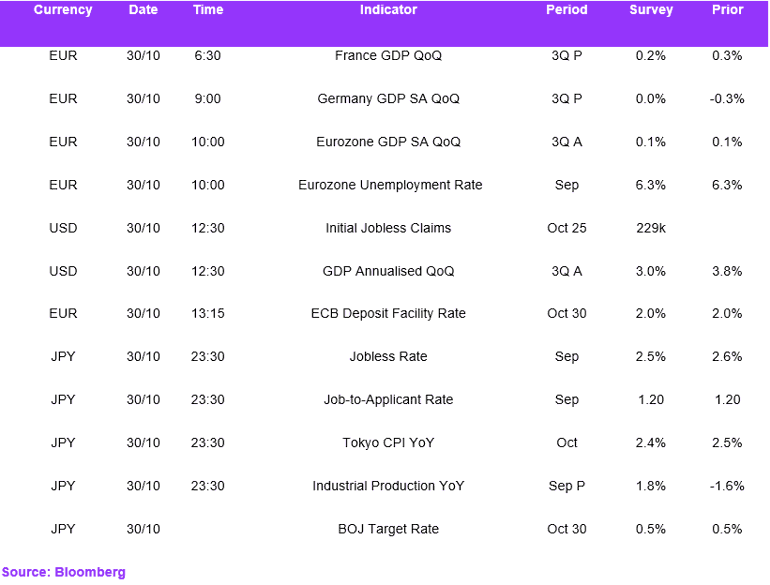
Economic Calendar