EUR / USD
EUR/USD jumped higher to 1.1545 amid a softening dollar environment, primarily driven by weaker labour data. According to data from Challenger, Gray & Christmas, US companies announced over 150,000 job cuts in October, primarily in the technology and warehousing sectors, as AI adoption continues to reshape hiring trends. These figures aligned with market sentiment, which has been leveraging weaker labour figures to call for Fed rate cuts. Notably, forward swaps now price in a 71% probability of a December cut, up from 61% just the previous day.
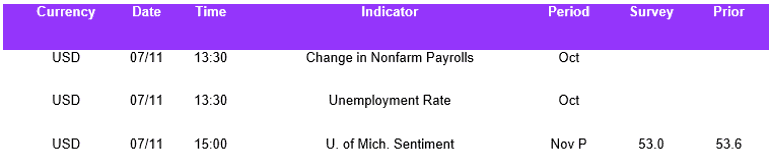
Despite prevailing market conviction pricing in a December rate cut, we remain unconvinced that the Fed will cut so soon. While the continued absence of reliable government data has injected a fresh wave of speculation into the rate narrative, we believe that this makes the Fed less likely to make a pre-emptive move before early 2026. This stands in contrast to the prevailing market consensus, which has doubled down on a continuous easing cycle following last month's cut, adding to bullish bias in US Treasuries, keeping the dollar pinned near key resistance at 100.50. However, we caution that with positioning becoming so one-sided and conviction for cuts reigniting, the risk of a hawkish Fed surprise is underpriced. Should Chair Powell signal that a December cut is off the table, markets could be caught off guard, triggering an abrupt repricing in Treasury yields and a sharp rally in the dollar as volatility returns to the forefront. With key nonfarm payroll data expected to be absent tomorrow, markets will likely turn to alternative sources of labour market data to assess the US macroeconomic outlook.
While the pair is now back above the 1.1500 mark, it is facing notable resistance at the convergence of the 50-day and 20-day moving averages, around 1.1600-1.1700, which we believe will cap the euro's upside in the near term, as the dollar appears to be growing structurally weaker.
USD / JPY
USD/JPY weakened to 153.00 as markets rejected prices above the 154.00-155.00 resistance bands, where there are concerns that potential intervention could occur. Still, the technical landscape indicates a neutral to bullish trajectory in the coming days, as the pair remains well-supported above both the 20-day and 50-day moving averages at 152.50 and 150.10, respectively.
From the fundamental perspective, markets are currently pricing a 50% probability of a BOJ rate hike by December 2025, while Governor Ueda maintains a cautious stance, seeking sustained wage momentum before implementing major policy shifts. Additionally, following weaker labour data from the US, markets have reaffirmed their expectations for a Federal Reserve cut in December, which has widened the yield differential.
Given the combination of these factors, we expect the pair to remain volatile, with markets attempting to test the 154-155 resistance band as macroeconomic headwinds weigh on the yen's performance.
GBP / USD
GBP/USD rallied yesterday, as a slew of dip-buyers emerged, driven predominantly by a resurgence of dip-buyers who seized the opportunity to enter the market at lower levels, pushing the pair up to a recovery point of 1.3146. The weaker dollar undoubtedly provided a favourable backdrop for the pound's ascent; however, it appears that the primary catalyst for this movement was the unwinding of heavily overextended bearish positions. This dynamic suggests that a robust support level may be establishing itself around the 1.3000 mark.
In stark contrast to yesterday's bullish sentiment, the current macroeconomic landscape indicates that bearish pressures should be weighing on the pair. The Bank of England's tight 5-4 decision to maintain rates at 4.0% reveals increasing dovish sentiment within the central bank. Market participants are now pricing in a 70% probability of a BoE rate cut in December, which could further weaken sterling's position against the dollar in the longer term. Moreover, the UK economy confronts substantial challenges, including planned fiscal tightening and expectations of major tax increases in the upcoming November 26th budget, while the cooling labour market and moderating wage growth add to sterling's longer-term headwinds.
The combination of structural challenges, including declining retail sales and stagnant GDP in the UK, coupled with the significant economic growth differential between the US and the UK, suggests continued pressure on GBP/USD in the coming weeks. However, in the near term, we pay more attention to dollar weakness, which could boost the pound slightly towards 1.3200.
Economic Calendar