EUR / USD
EUR/USD weakened by 1.0% since the start of this year, driven by divergent monetary policy trajectories and labour market conditions on both sides of the Atlantic. Recent US employment data showing softer-than-expected job growth has reinforced expectations that the Federal Reserve will maintain its current policy stance in the near term, with rate cuts unlikely until mid-2026 at the earliest. This cautious Fed posture supports the US dollar's relative strength despite mixed economic signals, as market participants price in a prolonged pause in monetary accommodation.
Meanwhile, Eurozone inflation data has remained at the European Central Bank's 2% target. Stable inflation in the eurozone, combined with growth concerns that have prompted some economists to forecast a modest expansion for the region, creates headwinds for euro appreciation.
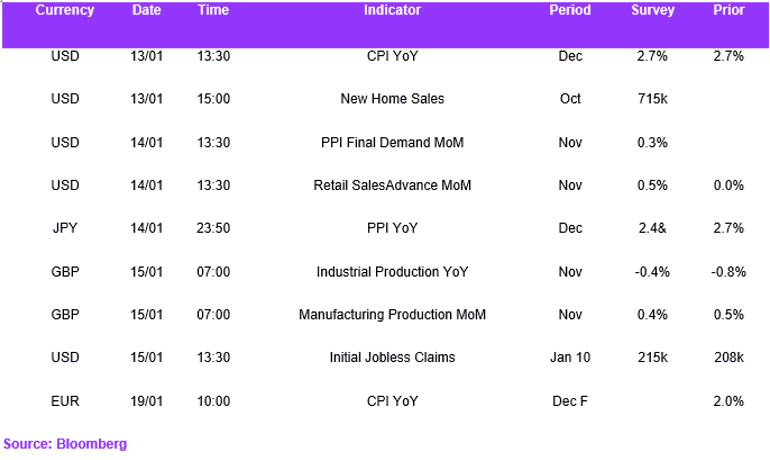
The upcoming week's critical inflation reports—including December CPI data—are expected to remain stable, which is likely to keep the current Fed expectations in place. Still, the interest rate differential continues to favour dollar positioning over the euro.
USD / JPY
The Bank of Japan's gradual monetary policy normalisation trajectory continues to shape the USD/JPY dynamic. The policy rate currently stands at 0.75%, following a December 2025 increase, which represents a 30-year high. This move signals Governor Kazuo Ueda's commitment to further rate increases, contingent upon wages and inflation aligning with the 2% target forecast.
The upcoming January 22-23 policy meeting markets approximately 10-15 basis points in hike odds, indicating investor expectations for continued tightening momentum, albeit not fully priced in until late Q1 2026. The narrowing rate differential between the US and Japan following the BOJ's rate hikes presents structural implications for carry trade unwinding dynamics that have historically impacted yen appreciation. The narrowing US-Japan rate gap, combined with recent Fed rate cut repricing, reduces the attractiveness of yen carry trades and suggests potential capital reallocation toward dollar-denominated assets.
Geopolitical tensions between China and Japan pose downside risks to Japanese economic growth through tourism and trade channels, potentially complicating the Bank of Japan's path toward further rate increases. The macroeconomic backdrop suggests the interest rate differential will remain the dominant factor influencing USD/JPY, with the pair's direction likely to test the January 2025 high of 158.87 as this trend persists.
GBP / USD
The GBP/USD weakened last week, driven by dollar strength, driven by softer-than-expected December employment data, which reinforced market conviction that the Federal Reserve will maintain an extended pause in its policy rate cycle. The Federal Reserve has signalled its intention to hold rates steady at the 3.5%-3.75% range through the near term, with core PCE inflation at approximately 2.7%, providing limited immediate impetus for additional cuts despite mixed labour market data showing 50,000 jobs added in December against forecasts of 60,000. In the UK, markets are pricing approximately a 40% probability of a further 25bps cut by the February 5 monetary policy meeting.
With no changes in central banks' monetary policy paths expected, the pair is more reliant on the dollar moves and the pair's technical indicators, with moving averages helping to limit the pair’s downside at 1.34.
Economic Calendar